
Understanding the Challenge: AAR in Aging Hydropower Infrastructure
Across the United States, there are more than 90,000 dams, and over 2,500 are hydroelectric facilities powering millions of homes and businesses. Many of these structures were built decades ago—often before modern concrete aggregate testing standards existed. As a result, an increasing number of these dams face alkali-aggregate reaction (AAR), a slow-acting but destructive chemical process within concrete that can compromise structural performance, alignment, and safety.
AAR causes internal expansion of the concrete matrix, leading to cracking, misalignment of mechanical components, and, in severe cases, compromised dam integrity. For the hydropower industry—where precise alignment of turbines, gates, and spillway systems is essential—this deterioration directly impacts both safety and generation reliability.
Recent research published by the U.S. Department of Energy, ICOLD, and university laboratories confirms that AAR remains one of the most significant long-term durability issues for concrete dams worldwide. In the U.S. alone, dozens of large hydro dams are under monitoring or remediation for AAR-related distress.
What is Alkali-Aggregate Reaction (AAR)?
AAR occurs when reactive aggregates in concrete interact with alkali hydroxides in cement paste in the presence of moisture. This reaction produces a swelling gel, which absorbs water and expands over time, generating tensile stress and internal cracking.
The key drivers are:
- Reactive aggregates containing amorphous or strained quartz.
- High alkali content in cement or admixtures.
- Constant moisture, typical of dam environments.
- Elevated temperature conditions that accelerate reactions.
The result is progressive cracking, differential movement, and in massive concrete structures such as dams—significant structural distortion that can affect embedded systems like turbine intakes, spillway gates, and powerhouse alignments.
Why AAR is problematic in Dams (Hydropower Structures)?
Some of the notable impacts of AAR on hydropower structures include:
Cracking and microcracking
AAR gel swelling induces tensile stresses in the cement matrix, which exceed the cracking strength, causing microcracks that may coalesce into larger cracks. These cracks can promote further ingress of water, exacerbating the process.
Loss of stiffness and strength
The integrity of the concrete decreases: elastic modulus reduces, strength is diminished, and the structural response under loading becomes degraded.
Distortions, deformations, displacement
In constrained structural elements (e.g. large dam blocks, intake galleries), the expansion is resisted and converted into structural forces that lead to displacements, warping, or misalignment. In hydropower, this might misalign components or distort the geometry of hydraulic passages.
Jamming or interference with mechanical elements
Swelling and displacement of concrete can impinge on gates, guide vanes, turbine interfaces, or other embedded mechanical components. For example, in one hydro station, expansion caused the “round throat ring liner” to deform into more of an oval shape, interfering with turbine operation.
Leakage and permeability increase
Cracks and damage reduce the tightness of concrete, enabling leakage, seepage, and hydrostatic pressure paths where none were intended. Over time, this can degrade internal zones and accelerate degradation.
Reduced life and safety margins
As deterioration accumulates, the margin to ultimate failure reduces. Under extreme conditions (e.g. seismic load, flood load), a compromised concrete structure may face a higher risk. Some numerical studies (e.g. “pushover analysis” under simulated AAR effects) have targeted failure mechanisms in dams affected by AAR.
Operational limitations and maintenance challenges
Even before structural failure, performance degradation may require generator de-rating, flow restrictions, or costly maintenance interventions.
Because hydropower plants often have very long design lives (50–100+ years), the slow but progressive nature of AAR makes it a serious concern for durability planning.
In short, the swelling, cracking, and internal stresses of AAR manifest in functional, structural, and operational impairment of hydropower concrete structures.
Traditional Mitigation Approaches
Engineers have used a range of methods to mitigate AAR, each with specific advantages and limitations.
|
Method |
Description |
Pros |
Cons |
|
Chemical or Lithium Treatments |
Lithium nitrate injection modifies the AAR gel to reduce expansion. |
Low invasiveness |
Limited penetration in large concrete masses; uncertain long-term performance. |
|
Surface Sealers & Coatings |
Moisture barriers applied to exposed surfaces. |
Reduces water ingress |
Ineffective for deep concrete; requires reapplication. |
|
Drilled Relief Holes |
Core drilling to locally relieve pressure. |
Simple and inexpensive |
Only local relief; limited effect on mass concrete. |
|
Anchoring or Prestressing |
External reinforcement to resist deformation. |
Adds structural restraint |
May oppose expansion forces and induce cracking. |
|
Segment Removal or Replacement |
Demolition and recasting of affected sections. |
Directly repairs damaged zones |
High cost, long outages, complex logistics. |
|
Slot Cutting (Expansion Slotting) |
Controlled sawing through the dam body to relieve compressive stress. |
Proven stress-relief mechanism |
Requires specialized design and monitoring. |
While several of these approaches slow the progression of AAR, few can actively relieve internal stresses that have already accumulated within a dam.
This is where slot cutting provides a distinct advantage.
Slot Cutting: Controlled Stress Relief through Precision Machining
Slot cutting—also known as expansion slotting or relief slotting—involves using diamond wire or saw technology to create vertical or inclined cuts through selected portions of a dam.
These cuts form controlled discontinuities that allow the concrete to expand and relieve internal stresses without causing uncontrolled cracking or large-scale demolition.
Typical slot widths range from 10–15 mm, and cuts are engineered based on location, depth, and spacing derived from stress modeling and monitoring data.
How It Works
- Mapping and Modeling – Engineers identify zones of maximum compressive stress using finite-element analysis and in-situ instrumentation.
- Precision Cutting – Diamond wire saws cut through the designated section with minimal vibration or structural disturbance.
- Monitoring – Sensors measure elastic rebound and ongoing movement.
- Optional Grouting – Slots may be stabilized or refilled with grout once sufficient relief is achieved.
- Maintenance – Over time, slots may close as AAR continues, requiring re-cutting at scheduled intervals
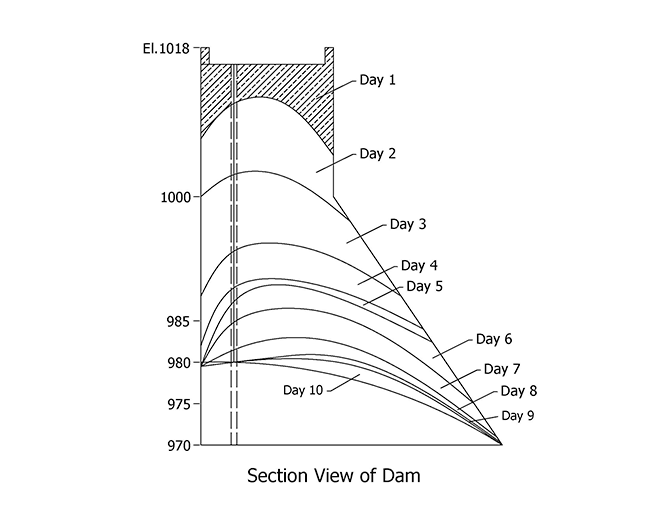
Field Applications and Case Studies
Fontana Dam (USA – Tennessee Valley Authority)
Constructed in the 1940s, Fontana Dam developed AAR-related expansion in its spillway piers. TVA engineers implemented vertical slot cuts using diamond wire saws to relieve compressive stresses. Periodic re-cutting—about every 5 years—has maintained stability for decades.
Mactaquac Dam (Canada)
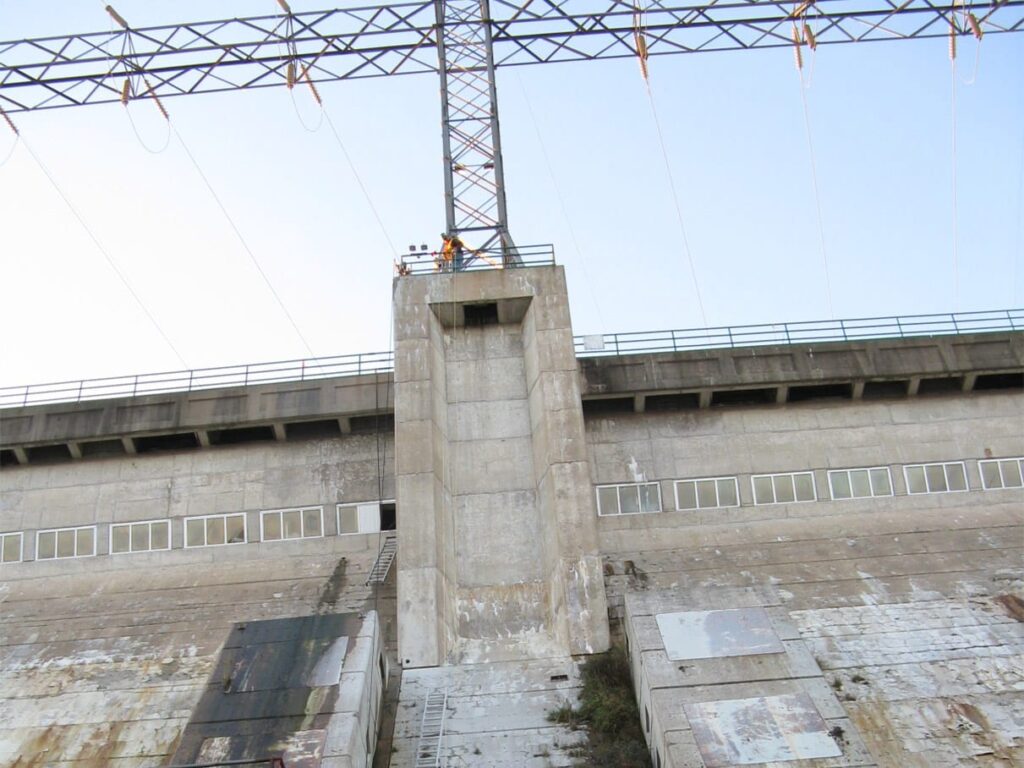
The Mactaquac Generating Station, one of North America’s largest concrete gravity dams, underwent slot cutting beginning in 1988. Vertical and transverse slots—some over 20 m deep—were used to mitigate AAR-induced deformation in intake and powerhouse blocks. Continuous monitoring has guided successful re-cut cycles, preserving turbine alignment and operational capacity.
European and South American Dams
Studies from ICOLD and university partners in Norway, Switzerland, and Brazil have documented multiple slot-cut interventions since the 1980s. Results confirm the method’s ability to reduce internal stresses, control displacement, and extend the structure’s service life when paired with ongoing monitoring.
Research Insight: Validated Through Modeling and Measurement
Recent computational research—such as Ben Ftima & Yildiz (2023), published in International Journal of Civil Structural Mechanics—has validated slot cutting through multi-physics finite-element analysis.
Key findings include:
- Strategic mid-depth slot placement can extend gate operability by 25+ years compared to untreated conditions.
- Combining slot cutting with grouting reduces crack width propagation by up to 40%.
- Performance metrics like Total Crack Width (TCW) provide a more complete measure of slot efficiency than displacement alone.
Complementary field studies (Caron et al., ICOLD Bulletin 79, and TVA records) further support slot cutting as a mechanically sound and field-proven AAR mitigation measure.
Advantages of Slot Cutting for Hydropower Dams
Precision and Minimal Structural Disturbance
The cut width is narrow (typically 10–15 mm), causing minimal removal of material and minimal weakening of adjacent zones. This is critically important in dams where large volumes of concrete must remain intact.
Ability to Cut Deep and Through Reinforcement
Diamond wire systems can cut through large thicknesses of concrete and intersect reinforcing bars or embedded steel, making them practical for deep slot cuts. For example, In-Place Machining (IPM) achieved a 30-meter plunge cut at the Chickamauga Dam.
Flexibility in Geometry and Access
Because wire routes through drilled holes, cuts can be made even where conventional saw blades can’t reach, such as narrow gaps or constrained regions. The wire can follow curved paths (with pulleys).
Lower Vibration and Lower Secondary Damage
Unlike jackhammers or heavy mechanical cutting, diamond wire abrasion is relatively low-vibration, reducing risk of inducing additional microcracking or damage adjacent to the slot.
Continuous Operation and Recuts
Slots can be re-cut relatively easily as swelling continues. Diamond wire allows repeat operations without major rework.
Controlled Removal, Smooth Faces, and Better Grouting Interfaces
The surfaces of the slot are smoother and more consistent compared to rough mechanical cutting, enabling better grouting and sealing if needed.
Scalability and Suitability for Large Structures
The method is scalable to very large mass concrete structures like dams. Many large projects have used it.
Predictable Cutting Forces and Optimization
Literature on diamond wire sawing provides models of cutting forces, parameters, wire deflection (“wire bow”), and process optimization. Understanding cutting forces allows planning for wire speed, feed rate, tension, and thermal dynamics.
Long-Term Viability for Dam Operations
Slot cutting provides decades of maintainable performance when integrated into a proactive maintenance program:
- Instrumentation & Monitoring: Install extensometers and crack gauges to track movement and slot closure.
- Data-Driven Re-cut Scheduling: Use displacement data to plan interventions before expansion stresses accumulate again.
- Hybrid Repairs: Combine slot cutting with grouting or anchors to enhance stability.
- Lifecycle Budgeting: Incorporate re-cut cycles into long-term maintenance forecasting.
Frequently asked questions about AAR for hydropower dam application:
How wide and deep are the cuts?
Cut width usually ranges from 10 to 15 mm depending on design intent. Depth can extend through the full dam thickness or a portion thereof, as defined by the mechanical model and reinforcement layout.
How long does one slot last before re-cutting is required?
Re-cut intervals depend on the rate of AAR expansion and environmental conditions. Some facilities (e.g., Fontana, Mactaquac) have recut every 10–20 years based on measured closure.
Can slot cutting be performed while the dam remains in service?
In many cases, yes. Slot cutting is low-vibration and can be performed on isolated structural segments or during partial drawdowns, coordinated with plant outages or scheduled maintenance windows.
How is the slot monitored over time?
Instrumentation such as crack gauges, displacement transducers, and invar wires are used to measure movement and closure rates. Data informs future recut planning and validates model predictions.
What are the environmental or safety considerations?
Diamond wire cutting produces minimal dust and vibration. Cooling water is managed with containment systems to prevent contamination, and all work follows dam-safety and confined-space protocols.
How does slot cutting compare to demolition or full reconstruction?
Slot cutting is far less invasive, faster, and significantly more cost-effective. It preserves the structure’s integrity, avoids long outages, and can be integrated into a long-term monitoring program.
Can slot cutting be combined with other mitigation methods?
Yes. Combining slot cutting with grouting, anchoring, or chemical treatment often yields the best results—relieving stress while enhancing structural restraint and reducing moisture ingress.
What is the expected long-term outcome?
When properly executed and monitored, slot cutting can extend a dam’s service life by several decades, maintaining operational alignment and preventing costly structural rehabilitation.
Conclusion
Slot cutting has evolved into a scientifically validated and field-proven method for managing AAR in concrete dams.
With its combination of precision machining, low vibration, scalability, and long-term manageability, it stands as a cornerstone solution for hydro operators seeking to extend dam life, improve reliability, and control costs.
To learn more about IPM’s slot cutting process and determine if it’s the right solution for your hydopower dam repair project, consult our team:
Call 414-261-3939 | Request service or quote: [email protected]
View our Comprehensive Hydropower Services: Link
References
- U.S. Department of Energy – Hydropower Market Report (2023)
- Federal Highway Administration – AAR Facts Book (FHWA-HIF-13-019)
- ICOLD Bulletin 79 – Alkali-Aggregate Reaction in Concrete Dams
- Ftima, B. & Yildiz, M. (2023) – Failure Mechanisms and Rehabilitation Scenarios for Concrete Hydroelectric Facilities Affected by AAR, SpringerOpen
- Caron et al. (2016) – Slot Cutting of Concrete Dams: Field Observations and Complementary Experimental Studies, ACI Structural Journal
- TVA – Fontana Dam Rehabilitation Program
- NB Power – Mactaquac Generating Station AAR Mitigation Reports
